

Organiser: Centre for Crisis Communication (CCC)
In Partnership With: Image Merchants Promotion Limited (IMPR)
Date: Monday, 9 – Friday, 13 November 2026
Venue: PRNigeria Centre, Kano State
Theme: Communicating with Intelligence: Harnessing Artificial Intelligence, Strategic Communication and Crisis Communication for National Security and Public Trust.
1. BACKGROUND AND OVERVIEW
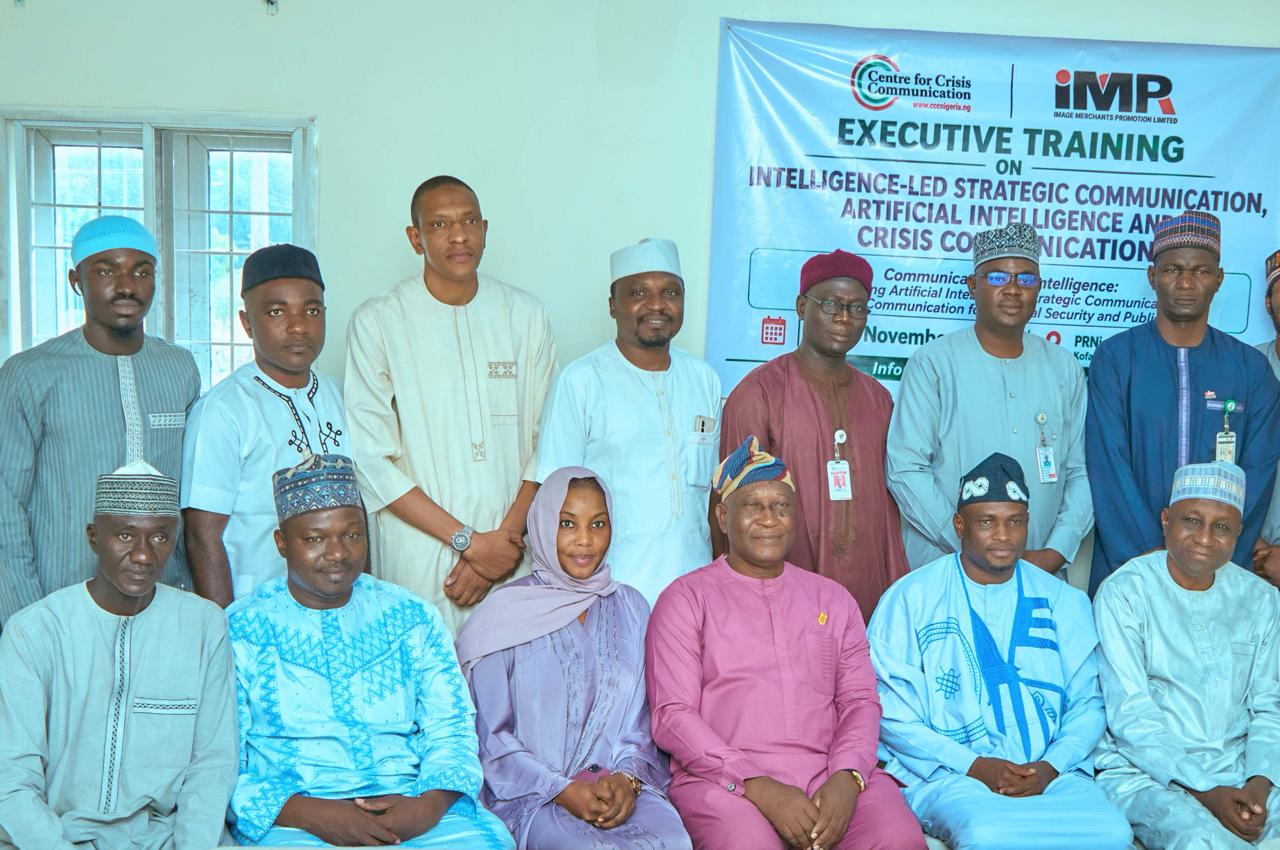
The Centre for Crisis Communication (CCC), in partnership with Image Merchants Promotion Limited (IMPR), organised a five-day executive capacity-building training on Intelligence-Led Strategic Communication, Artificial Intelligence and Crisis Management from November 9 to 13, 2026, at the PRNigeria Centre, Kano State.
The programme was designed to strengthen the professional capacity of communication practitioners and public information officers, particularly those serving in security agencies, government institutions and regulatory bodies. It focused on equipping participants with practical knowledge and skills in artificial intelligence, intelligence-led communication, information management, institutional leadership and crisis response.
The training also provided a platform for examining the changing information environment, the implications of emerging technologies for national security and the importance of timely, coordinated and credible communication in building public trust.
2. OPENING CEREMONY
The training was formally declared open by the Kano State Commissioner for Information and Internal Affairs, Malam Sanusi Bature Dawakin Tofa.
The opening ceremony featured a keynote address by the Chairman of the Board of IMPR, Professor Sule Ya’u Sule; a welcome address by the Chief Executive Officer of IMPR, Mallam Yushau Shuaib; and opening remarks by the Chairman of CCC, Major General Chris Olukolade (Rtd.).
The addresses highlighted the growing importance of strategic communication, technological adaptation and institutional preparedness in addressing contemporary communication and national security challenges.
3. PARTICIPATING INSTITUTIONS
The programme brought together communication professionals and representatives from government, security and regulatory institutions. A total of 16 participants were drawn from the following institutions:
● Nigerian Customs Service (NCS) – 5 officers
● Nigerian Army (NA) – 1 officer
● Nigerian Navy (NN) – 3 officers
● Nigerian Institute of Public Relations (NIPR), Kano Chapter – 1 participant
● Nigerian Institute of Public Relations (NIPR), Jigawa Chapter – 1 participant
● Nigerian Nuclear Regulatory Authority (NNRA) – 2 participants
● National Agency for the Prohibition of Trafficking in Persons (NAPTIP) – 1 participant
● Defence Space Administration (DSA) – 2 participants
4. TRAINING SESSIONS AND TECHNICAL FOCUS
The programme featured expert-led lectures, practical demonstrations, hands-on exercises and interactive engagements covering four major training areas:
a. Hands-on AI Lab – Dr Isa Musa
A practical session introducing participants to the application of artificial intelligence tools, with emphasis on direct engagement, experimentation and the use of AI in professional communication tasks.
b. Applied AI Tools: Prompting and Workflow – Dr Isa Musa
This session explored practical approaches to prompt engineering, AI-assisted workflows and the effective use of artificial intelligence tools to improve research, productivity, content development and communication processes.
c. Training AI for Strategic Communicators – Alhaji Yushau Shuaib
The session examined the application of artificial intelligence in strategic communication, including how communication professionals can leverage emerging technologies for information management, audience engagement, strategic planning and institutional communication.
d. Leading Communication in Complex Institutions – Hassan Yakubu
This session focused on the leadership and management demands of communication within complex institutional environments, highlighting coordination, organisational dynamics, strategic alignment and effective communication leadership.
5. KEY AREAS OF ENGAGEMENT
Beyond the technical sessions, the training provided opportunities for participants to examine critical issues shaping contemporary strategic and crisis communication, including:
– The application of artificial intelligence in institutional communication and crisis management.
– Misinformation, disinformation, deepfakes and emerging information threats.
– Intelligence-led approaches to strategic communication and information management.
– Digital verification, open-source intelligence and information integrity.
– Institutional preparedness, crisis response and public trust.
– Inter-agency collaboration and coordinated communication during emergencies.
– Ethical considerations and responsible application of emerging technologies.
6. PARTICIPANTS’ FEEDBACK AND TESTIMONIALS
The training received positive feedback from participants, who expressed appreciation for the quality of instruction, practical learning opportunities, knowledge shared by facilitators and the opportunity to interact with professionals from different institutions.
Some participants described the programme as an impactful learning experience that strengthened their understanding of artificial intelligence, intelligence-led strategic communication and crisis management.
Selected testimonials include:
1. Sub Lieutenant Promise U. Ikpatim
Nigerian Navy, NNCETT, Ile-Ife, Osun State
“The programme has significantly enhanced my understanding of intelligence-led strategic communications, artificial intelligence and effective crisis management. The training has further enhanced my knowledge of several AI tools, prompting and workflow. Thank you for the invaluable knowledge and experience.”
2. Assistant Superintendent of Customs M. U. Balarabe
Nigerian Customs Service (NCS)
“It was indeed a great privilege and opportunity to meet and interact with such wonderful personalities. I sincerely hope the relationships established will continue to grow and be cherished.”
3. Chief Superintendent of Customs T. Y. Balarabe
Nigerian Customs Service (NCS)
“I sincerely appreciate the organisers for sharing their wealth of knowledge and expertise. It was indeed a worthwhile experience. I appreciate everyone’s participation and valuable contributions throughout the workshop.”
These testimonials reflect the value participants attached to the training, particularly its practical learning components, professional knowledge exchange and opportunities for cross-institutional networking.
Note: The testimonials presented above are selected feedback received from participants. Additional testimonials may be incorporated as they become available.
7. KEY OUTCOMES AND EMERGING DIRECTIONS
The training reinforced the importance of integrating technological innovation, professional competence and institutional coordination into Nigeria’s strategic communication architecture.
Among the major directions emerging from the programme were:
1. Strengthening the capacity of communication professionals and institutional spokespersons to use artificial intelligence responsibly and effectively.
2. Improving inter-agency information-sharing and coordination to support early warning, verification and crisis response.
3. Promoting intelligence-led strategic communication as an essential component of national security and public trust.
4. Enhancing institutional preparedness against misinformation, disinformation and AI-generated manipulative content.
5. Strengthening professional standards, ethical communication and continuous capacity development.
6. Advancing the planned activation of the Crisis Communication Hub (CCHub) as a platform for information monitoring, threat assessment, verification and coordinated crisis response.
8. COMMUNIQUÉ
At the conclusion of the training, a draft communiqué was prepared to capture the observations and recommendations arising from the presentations, practical exercises and deliberations.
The draft addresses the implications of artificial intelligence for national security, the growing threats posed by misinformation and disinformation, the need for inter-agency collaboration, institutional capacity development and responsible communication ahead of the 2027 general elections.
Status: The communiqué remains a working draft and has not yet been formally adopted. Further corrections and revisions are required before its final approval and issuance.
9. CONCLUSION
The five-day executive training provided a platform for strengthening professional knowledge, practical competencies and institutional understanding of the evolving relationship between artificial intelligence, strategic communication and crisis management.
Through expert presentations, practical engagements, institutional discussions and positive participant feedback, the programme underscored the need for communication professionals to adapt to emerging technologies while maintaining the principles of accuracy, accountability, professionalism and public trust.
The initiative further reinforced CCC’s commitment to strengthening crisis communication capacity, promoting inter-agency collaboration and supporting a more coordinated and resilient national communication framework.